
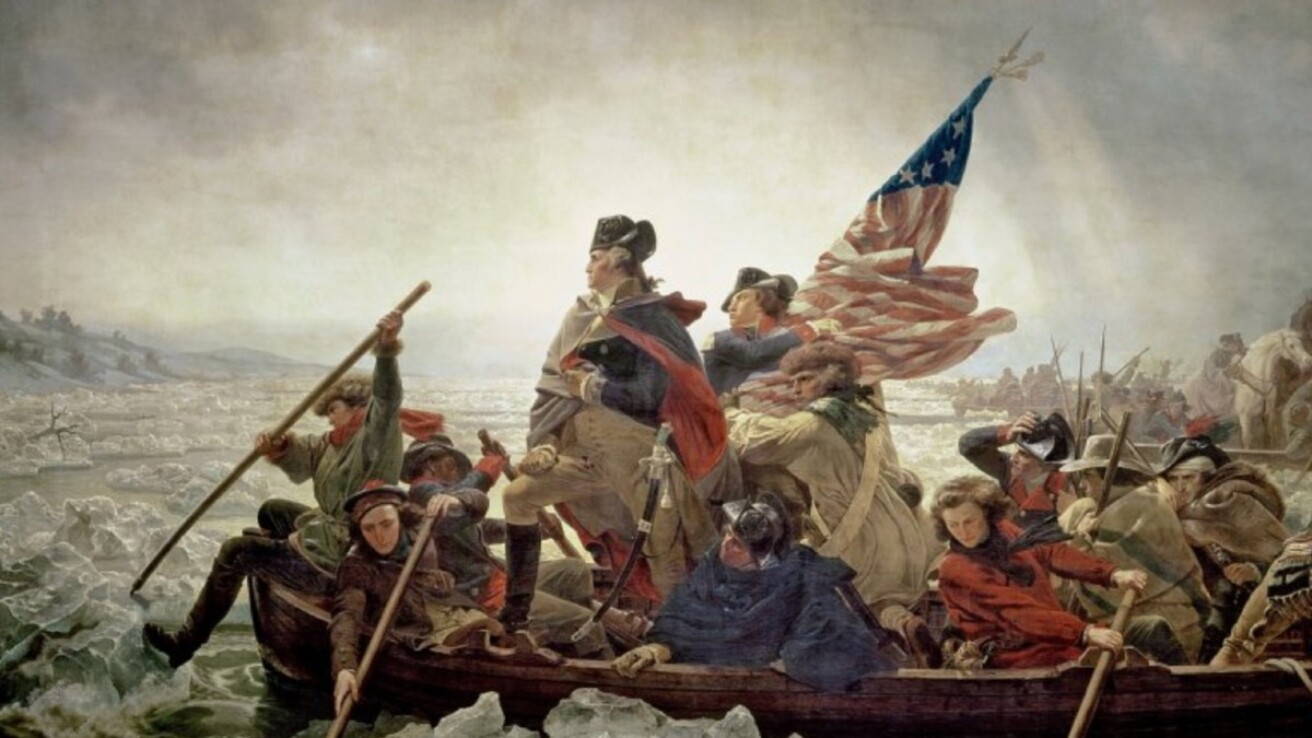

What do you know about George Washington? I mean, what do you really know? We’re celebrating the 250th birthday of America and a strong argument could be made that we wouldn’t exist as a nation without one single man: Washington.
Were there other generals who could have led the Continental Army to victory in the Revolutionary War for the thirteen colonies? Perhaps. General Charles Lee certainly believed he was capable. Nathanael Greene and Henry Knox were possibilities. And a few others rose to the occasion who “maybe” had a shot, but if you look back on the Revolution, there was only one indispensable man.
The funny thing is that outside of a few instances of grit and creativity, Washington is not considered an exceptional military tactician. Even during the revolution his biggest critics could point to legitimate issues with the way he waged war and fought the British, mainly that he rarely did. In fact, there’s a general consensus that the greatest feat Washington pulled off during the Revolutionary War wasn’t the Battle of Trenton or Valley Forge, rather, it was the fact that he kept the Continental Army together at all.
This was a ragtag, untrained, poor, barely fed, improperly dressed, rarely paid group of thousands of Americans who endured unimaginable suffering every winter for the right to fight the most powerful land army the world knew at the time: the British Regulars.
Desertions. Death. Disorderly conduct. Despair. Month after month Washington pleaded with congress for more money, more food, more ammunition, more uniforms, more men. And month after month they denied him, while dining in nice restaurants and staying in nice hotels and holding up in farmhouses and mansions in New York, Philadelphia, Boston and more.
All while Washington did everything he could to keep the men from disbanding. Were there smarter military men? For sure. Was there anyone else who could keep the army together for eight years? No. There likely wasn’t.
Which is why on the 250th anniversary of the signing of the Declaration of Independence, an independence which may have lasted but a half-decade or less without Washington, I wanted to share some of my favorite facts and feats about him with you because I’ve read just about every biography of him that exists. And some of my favorite stories about him happen before he even became president. The man was, in no uncertain terms, a physical specimen:
New to Midlife Male? Sign Up Now for Free
When Washington was in his twenties he worked as a surveyor in the untamed woods of the Ohio Valley. As he traipsed through hundreds of miles of wilderness there were no towns, no tools and very few people. It was also freezing as his work carried him through the winter. No matter. Washington built rafts to travel the Ohio River with nothing but his bare hands and his legendary brawn; pulling trees from the ground, splitting trunks and breaking branches. He also hacked new trails by physically removing the growth in his way – for hundreds of miles. He once got stranded in a blizzard on the way home, waded through an icy river and spent the night on a small frozen island, before hauling himself through ice chunks back on land and then hiking miles soaking wet to a cabin.
As a General of the Continental Army, Washington was constantly in the presence of men who looked up to him, both literally, as their leader, and physically. The average height for a man in the late 1700s was a shade under 5’8” with a weight of 160 pounds or so. At 6’2” and nearly 220 pounds, Washington towered over his men (and almost all other men of his day). And occasionally, he liked to show off his raw power.
The famous colonial painter, Charles Wilson Peale describes one such moment that took place at Mount Vernon in 1773, when several men visiting his property were competing in a game of “pitching the iron bar” which is basically a javelin contest but instead of seeing how far you can throw a well crafted, aerodynamic javelin, men in the 1700s competed to see how far they could chuck a giant heavy metal rod.
Towards the end of the competition, Washington appeared and while still wearing his coat, reached out his hand for the rod. I’ll let Peale explain what happened next.
“No sooner…did that heavy iron bar feel the grasp of his mighty hand than it lost the power of gravitation and whizzed through the air, striking the ground far, very far, beyond our utmost limits,” he said.
And if that’s not enough, Washington put a little icing on the cake by talking some smack as he admired his throw.
“When you beat my pitch, young gentlemen,” he said. “I’ll try again.”
Boom. Chalk one up for POTUS #1.
And there are plenty of other stories about Washington’s rocket launcher of an arm.
His step-grandson, George Washington Parke Custis, confirmed that he witnessed the General hurl a piece of slate clear across the Rappahonnock River at Fredericksburg; a feat many men had tried but all had failed to do.
Another seemingly impossible challenge that tempted strong-armed men of the area was throwing a rock over the Natural Bridge formation in Rockbridge County, Virginia, which stood 215-feet tall. Of course, Washington was the first (and only) person of his era to do it.
And rest assured, GW didn’t just use his formidable strength to break the boundaries of how far or how high he could throw things. At age 18 Washington enrolled in Reverend James Maury’s Academy at Fredericksburg, Virginia and began wrestling in the “collar and elbow” style that was popular in his day. In a very short time, Washington became the champion of the academy, then the county and it’s rumored (though not confirmed) that he was the colony champion as well.
His wrestling skills remained throughout his life and he occasionally broke them out to prove a point. When he was 47 a group of Massachusetts Volunteers who heard about Washington’s wrestling skills as a young man were getting a little full of themselves and talked about how they could take the general. Never one to back down from a challenge, Washington, twenty years the men’s senior, said he’d take on anyone who thought they were up to it. In an 18th century Royal Rumble of sorts, Washington laid the smack down and defeated seven consecutive challengers.
He was also a lifelong swimmer, archer and billiards player, but if you asked Americans in the colonies what Washington was best at, they wouldn’t have said throwing things or even wrestling; they would have said horse riding.
No less than Thomas Jefferson said that Washington was “the best horseman of the age”. Nearly everyone who saw him on a horse came away with the same impression, with one description stating that he, “rode as he did everything else, with ease, elegance and with power.”
Your first President, fellas.
Happy Fourth of July!

midlifemale
midlifemale
midlifemale
Jon Finkel
Editor-in-Chief, Midlife Male
follow me on Twitter/X, Instagram, and LinkedIn.
Check out my latest books at jonfinkel.com
midlifemale
midlifemale
midlifemale
Join 50,000+ driven men over 40 getting free weekly advice on maximizing their health, wealth, and fulfillment in midlife. Subscribe here.