

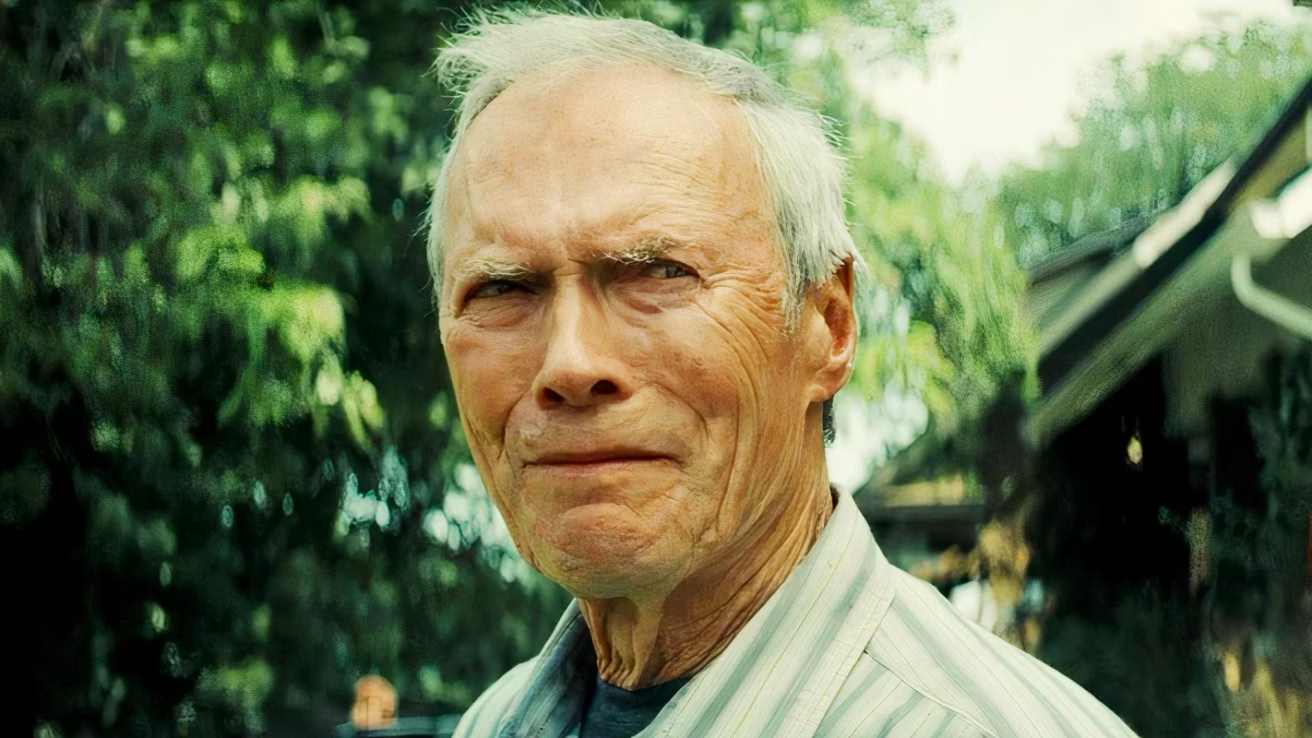

Pick your meme: Old man shouting at clouds. Clint Eastwood squinting and saying, “Get off my lawn.” Whatever. It’s easy for men over 40 to get painted as nostalgia addicts; guys who pine for the 80s and 90s constantly muttering stuff like, “everything used to be better.”
I know. I know. Every modern generation says their heyday is the best.
But I am here to tell you that they’re wrong. Ours was the best. And I’m going to prove it, if you’ll allow me a little objectivity as someone fast-approaching his fifth decade.
You ready? Okay, let’s go. In many measurable, specific ways, as technology has improved and ideas have spread faster than ever before, many “things we do every day” have become more of a hassle, more annoying, and less streamlined, even though tech kinda made us think we’d get the opposite.
Two things: I’m not talking about awesome stuff like medical breakthroughs or energy breakthroughs or capital ‘B’ big-time tech advances. I’m talking specifically about the way the promise of tech was beginning to remove useless friction from our day-to-day lives and how we were almost there – then everything went to shit.
If you’d like me to define what period of time I’m talking about, you can skip over the 70s, 80s and most of the 90s (the pre-everyone online world).
I’m talking about the early 2000s-ish. Let’s say, generously, 2000 to 2008 or so.
That short, glorious period where it felt like so many irritating little problems and daily inefficiencies in life were finally being solved.
New to Midlife Male? Sign Up Now for Free
Remember when we could first book a flight online? No more calling airlines. No more tickets sent to your house. You could go online, type in the cities you were traveling to, see a price, pick a seat and click “buy”. Done. Took about five minutes.
Now? I don’t even need to explain it to you. You hate it. I hate it. The price algorithm is a monster to deal with. Rates change constantly. Then when you find the flight you want, there’s 17 choices to make: executive leg room, leg room plus, main cabin, loser seat by the toilet, premium boarding, regular boarding, boarding last with morons. Then you have to select your bags. And there’s a fee for that. And they ask if you need a car. Or hotel. Or insurance. The whole process blows now.
The airlines had one job: to make buying flights online easy and they were this close in the 2000s. Now it feels like taking a goddamn scantron test from high-school just to get from Fort Lauderdale to Denver.
In the early 2000s we had the best of both worlds for retail and entertainment purchases as well.
You could buy books and stuff online with early Amazon, that was cool. But you could ALSO spend an afternoon at Blockbuster or Tower Records or Strawberries (for all my New England readers).
These days? Online only. The in-person browsing experience is mostly dead. No cruising aisles and bumping into friends. No good looking girls working the counter. No skimming. No off-screen, lazy meandering.
If you were a sports fan, one of your biggest complaints in the 90s used to be that you couldn’t watch all of your team’s games and it was hard to program your VHS to tape shows or movies you weren’t home for.
By the early 2000s? Problems solved.
First, TiVo was a godsend. One remote. One box. Save shows with the push of a button. Could not be easier.
Second, DirecTV. You had NFL Sunday Ticket, MLB Extra Innings, and NBA League Pass. If you wanted to spend the money, you could watch every game, right there on your screen. One guide. A thousand channels. Beautiful.
Even food was improving. McDonald’s and Taco Bell had been around forever, but new places popped up that focused on fresher, higher-quality fast-casual food. Chipotle. Panera. For a minute there in the mid-2000s it felt like you could get a quick meal, at a decent price, that was somewhat healthy for you (or at least with better ingredients). We’d earned it. Healthy, fast casual food. You can’t screw this up.
And when social media started, you were actually being social. The people you followed on Facebook were people you knew in real life. When you wrote something on early Twitter, people saw it. There was a sweet spot. Most users couldn’t even pronounce the word ‘algorithm.’ We were all in it together.
Even customer service felt like it was getting better. You could leave your number and get a call back instead of sitting on hold forever. You could register a warranty for an item online. You could hold your mail if you went on vacation through the Post Office website.
A bunch of little things like that made you think we were headed in the right direction. There was this sense that some of the long-time annoyances in life, the daily admin junk we all deal with, were finally being solved by technology.
Now everything is somehow more annoying. If you call and need help with a major company, you often find yourself trapped in a never-ending AI chatbot loop, begging to talk to a human. Then the human they finally connect you with is 3,000 miles away and doesn’t speak English very well. Of course, the calls are monitored for ‘quality assurance,’ although there is never any quality to speak of.
Our TV-watching sports utopia has disintegrated.
We went from having everything in one place to needing five or six different streaming apps just to watch the NFL or NBA. Your team’s on Thursday Night Football? It’s on Amazon Prime. So you can’t flip around. You’ve got to go in and out of apps, back to your home screen, sign in somewhere else, and hope it works. The prices go up. They split the content across platforms. Some things are on ESPN+, some on Netflix, some on Peacock. Stuff you already paid for disappears, like what’s happening now with ESPN and YouTube TV. In the end, the consumer, in every case, gets screwed.
There’s a word for this with tech: enshittification.
It’s real and it goes like this: build an awesome product, gain a zillion users by making the awesome product free or cheap, constantly promote how this product is more awesome than what exists and let your customers enjoy all the benefits… THEN, slowly start to charge for those benefits with a nominal fee, then a larger fee, then start putting whole aspects of the product behind a paywall for a monthly fee, then start segmenting more so that you can have monthly tiers of paywalls and, voila, soon the awesome product is super expensive and sucks. Well done, tech!
Happens in food, too.
Look at Chipotle. A microcosm for a good idea destroyed. It used to be known for large portions of healthy-ish food (depending on what you ordered), mostly fresh, mostly tasty, served in a pristine restaurant with pleasant people behind the counter.
Now you get 30% less food, for 40% more cost, the ingredients are gross, and the restaurants are a mess. As comedian Shane Gillis jokes, the people serving you look like you’ve ruined their day just by showing up. They make your food “with a side of disdain” as he says.
We haven’t been in over a year, and it used to be my son’s favorite place. Even he stopped asking to go.
Travel. Entertainment. Sports. Food.
All were on a trajectory to be amazing in the mid-2000s.
Now? Worse.
Have I made my case?
This is why guys over 40 always say things used to be better.
Because compared to the daily admin nonsense we put up with now, they were!
Disagree? Let me hear it.

midlifemale
midlifemale
midlifemale
Jon Finkel
Editor-in-Chief, Midlife Male
follow me on Twitter/X, Instagram, and LinkedIn.
Check out my latest books at jonfinkel.com
midlifemale
midlifemale
midlifemale
Join 50,000+ driven men over 40 getting free weekly advice on maximizing their health, wealth, and fulfillment in midlife. Subscribe here.